
Whether you just bought your first sewing machine or have been sewing for years, Martha Stewart’s Encyclopedia of Sewing and Fabric Crafts will open your eyes to an irresistible range of ideas. A comprehensive visual reference, the book covers everything a home sewer craves: the basics of sewing by hand or machine, along with five other time-honored crafts techniques, and step-by-step instructions for more than 150 projects that reflect not only Martha Stewart’s depth of experience and crafting expertise, but also her singular sense of style.
 Encyclopedic in scope, the book features two main parts to help you brush up on the basics and take your skills to a new level. First, the Techniques section guides readers through Sewing, Appliqué, Embroidery, Quilting, Dyeing, and Printing. Following that, the Projects A to Z section features more than 150 clever ideas (including many no-sew projects), all illustrated and explained with the clear, detailed instructions that have become a signature of Martha Stewart’s magazines, books, and television shows.
 A chapter on doll making.
 A chapter on wall décor.
 Beautiful photographs, as always
  This CD comes with the book, containing printable and downloadable PDF templates and patterns for the projects in the book.
  This is the splash page on your screen once the disc is loaded.
An enclosed CD includes full-size clothing patterns as well as templates that can be easily produced on a home printer. Fabric, thread, and tool glossaries identify the properties, workability, and best uses of common sewing materials. And, perhaps best of all, when you need it most, Martha and her talented team of crafts editors offer you the reassurance that you really can make it yourself.
The projects are as delightful as they are imaginative, and include classic Roman shades, hand-drawn stuffed animals, an easy upholstered blanket chest, a quilted crib bumper, French knot-embellished pillowcases and sheets, and Japanese-embroidered table linens, among many others.With gorgeous color photographs as well as expert instruction, this handy guide will surely encourage beginners and keep sewers and crafters of all experience levels wonderfully busy for many years to come.
Photos by Laura Normandin, MSLO
The projects are as delightful as they are imaginative, and include classic Roman shades, hand-drawn stuffed animals, an easy upholstered blanket chest, a quilted crib bumper, French knot-embellished pillowcases and sheets, and Japanese-embroidered table linens, among many others.With gorgeous color photographs as well as expert instruction, this handy guide will surely encourage beginners and keep sewers and crafters of all experience levels wonderfully busy for many years to come.
Photos by Laura Normandin, MSLO


 Majestic granite staircases lead visitors to all the various terraces and sections of the landscape that immediately surround the property.
 The stone railings of the pergola off the living room look almost Mayan in scale.
 Perennial kiwi vines (Actinidia) and dark purple elephant ears (Colocasia esculenta) soften the edges of a granite wall and staircase.
 One of the few flowering plants Jensen called for in the landscape was lilies. Here they feel quite at home in planting niches that line one of the stairways connecting the terraces to the grounds.
 A painterly use of plants on this stairway leading up to the south terrace.
 Pathways of pine needles (consistently cleaned of any debris) connect the various sections of the property. Jensen was a great proponent of 'circulation systems' outdoors that guided the explorer gently and easily through the landscape.
 Jensen designed the landscape to be emblematic of the Maine coast itself: rugged and lush. Martha installed a subtle lighting system to help illuminate the pathways for treaders at dawn and dusk.
  The playhouse on the property is one of several outbuildings. Designed by Candler, it features a massive stone fireplace, pool tables and squash courts within.
 Water features are key to almost every Jensen landscape. Skylands was no exception. Jensen believed the sound that water makes as it trickles over stone has inexplicable healing powers for the human soul. As such, he designed several natural pools, ponds and fountains on the property.
 One of Jensen's signature elements is the intersection of flowing water and a main pathway. This feature is found at several other properties designed by Jensen for the Fords, including Fair Lane, in Dearborn, Michigan. The philosophy behind such a design is to interrupt the walker and cause him to pause and reflect, to be aware of his surroundings and the inherent beauty.
 A cliff at the edge of the mountain meadow is topped by a crenellation of large boulders, similar to the "Rockefeller teeth" that line the property's crushed-granite driveway and the routes leading to Acadia National Park. A large pond plays centerpiece to the meadow's curves and hillsides.
 Reflecting pools along the edges of pathways catch raindrops and form miniature ecosystems.
  A beautiful wooden gate, left unstained and gorgeously aged by the elements, opens to the service entrance. Crushed pink granite covers the driveways of the property. Each fall it is collected, cleaned and stored for the following year.
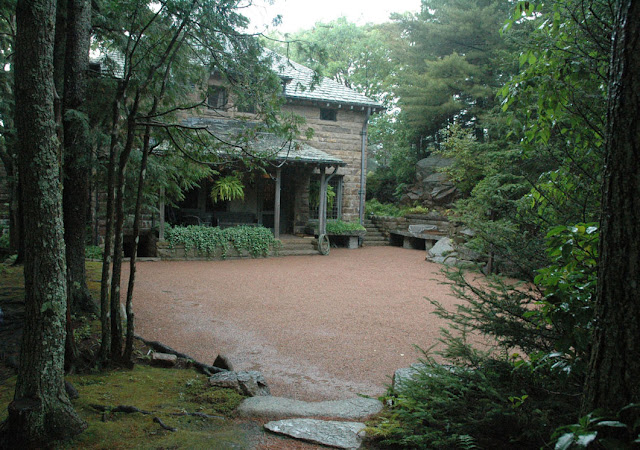 Originally designed to be used only by the staff and servants, the service area, which once functioned as a laundry yard, is actually a favourite of Martha's. She frequently uses this expansive outdoor space for entertaining and is often where she enters and exits the home.
  Not far from the service entrance is the council circle. Originally in Jensen's plans, but not constructed by the Fords, it is another feature much loved by Jensen. When Martha purchased the property in 1997, she had the council circle built, based on Jensen's plans. Its circular shape encourages conversation and a feeling of equality among its visitors. At its center is a fireplace for warmth and contemplation.
 Along the granite benches is a firebird motif, also in the original plans. Jensen explained the design to the Fords in one of his letters:

 This portion of the property was adjacent to the location of a tenant cottage for Eleanor Ford's mother, which is where she stayed when the main residence was being built. After the completion of the home, however, the cottage was razed and only the foundation remains. This portion of the property is located at the edge of an extremely steep cliff overlooking the ocean. Eleanor had asked Jensen to plan an elaborate cutting garden here with benches for seating, shown above. Today, the gardens are gone but you can see a glimpse of the plans below, formal in its layout and design
 Sources: