Showing posts with label books. Show all posts

12.12.2022

"Entertaining" Turns 40!

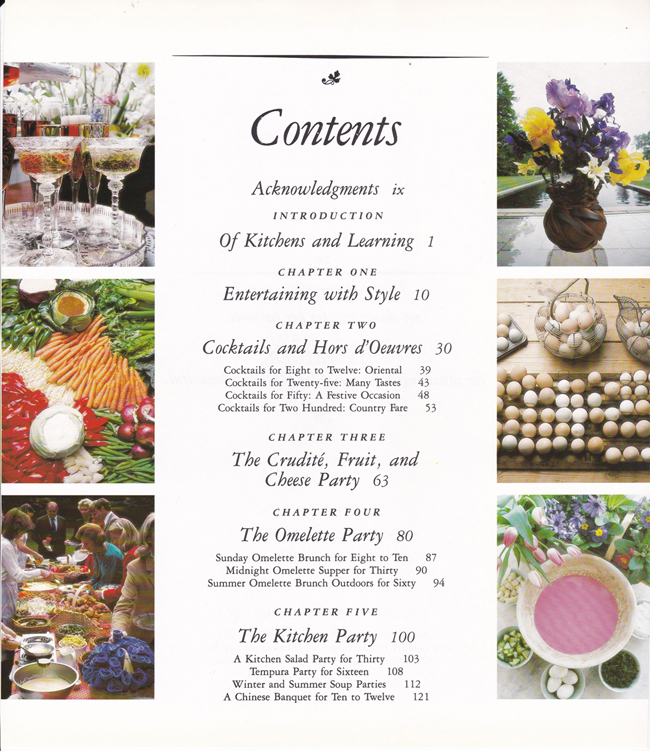
 Martha's landmark first book will turn 40 years old this week! Published in December of 1982, "Entertaining" was to become the foundation for all that Martha accomplished in the decades that followed, setting her course as America's leading arbiter of taste, home cookery and home keeping. 

It was Alan Mirkin, an executive at Random House, who convinced Martha that she was capable of writing a book about the subject of hosting parties. He had been a guest at many of Martha's catered affairs, as well as at her home for many of her parties. The two became friends. Martha took her book plan to Clarkson Potter who gave her the okay with Mirkin's backing, and production began in earnest with Martha documenting many of her catered events and private dinner parties at her home, Turkey Hill, in Westport, Connecticut, with recipes for the menus and photographs of the completed dishes. 

When it was suggested that the book be printed in black and white, Martha insisted that the beautiful photographs in the book (which were taken by her then husband Andrew Stewart and photographer Michael Skott) be published in colour.  Having underestimated Martha's appeal, the publisher initially printed only 20,000 copies, which immediately sold out, forcing Clarkson Potter to follow up with a second printing of 500,000 copies. Today, Entertaining is one of the bestselling cookbooks of all time, having sold well over one million copies. 

What makes it such a treasure is the scope of its vision. Martha's determination and imagination are on full display on every page, surrounded by imagery that documents the resplendent results of her efforts: tables dressed with quilts and then laden with cakes and desserts under towering flower arrangements, or a table set perfectly for a formal dinner party under a crystal chandelier by a roaring fire. In the early 1980s, Martha intuitively understood the ambitions of her peers to have a home filled with fine food and good friends. 

The book helped to introduce Martha to the American public and what followed, in addition to many more books, were television specials, a partnership with Kmart, a magazine, a weekly television series that later aired daily, and finally a company that produced not only content through all media but produced the products to support the lifestyle the company promoted. Entertaining was the first step in Martha becoming Martha. 

I'm happy to celebrate this book's 40th anniversary. Below are quotes from the book that illustrate Martha's intentions for the book and some of her advice for hosting. Enjoy!

"I hope this book will give people ideas, just as other people, stories, experience, and food itself have me ideas. It is not intended only for the culinary elite, who are working to refine their cuisine, but especially for all those people who regard cooking as "preparing meals", as drudgery or duty - and entertaining as an even greater worry. For them, I hope to show that there are many ways of entertaining and that each ultimately depends not on pomp or show or elaborate technique, but on thought, effort, and caring - much like friendship itself."
"Entertaining is an opportunity to be individualistic, to express your own ideas about what constitutes a good party. For one hostess, it might be a small and elegant dinner, with poached salmon; for others, a large and boisterous pasta buffet, make-your-own sandwiches and an old movie, omelets on the patio, or tempura in the kitchen. There are as many good formulas as there are personalities."
"My catering business began by chance. I had taught a cooking class for my daughter, Alexis, and her peers. Then, tentatively, I placed a single ad in the local papers offering my services as a caterer, only to find myself preparing blindly for a wedding for three hundred. The menu was a novice's - extravagant, demanding and unprofitable: hors d'oeuvres, homemade pates, cold cucumber soup, salmon mousses, chicken breasts chaud-froid, and homemade breads. Down by Long Island Sound, on a sweltering August afternoon in an unsheltered beach club in Darien, I stood by the buffet and watched the aspic melt off the oeufs en gelee, and the top tier of a basket-weave cake slip starboard. I eliminated the oeuffs and pushed the cake back into place. Nevertheless, it was a very good party, and I knew I was hooked."
"Think of how the colors of your food might contrast or complement your dishes; think, too, of how the colors work together on their own. Sometimes the size of the ingredients makes a statement. Carrots left whole and then aligned in a graceful diagonal on a plate have a different, interesting look. A stew appears dramatically hearty if you choose large mushrooms and whole vegetables (baby carrots, new potatoes) and cut the meat into two-inch cubes. A chicken salad composed of big chunks of white meat makes an extravagant statement, while the same ingredients finely julienned make a delicate one. A sweet spring lamb is more appropriately carved into several thin slices than one hefty slab. In assembling a plate, respect the integrity of and the nature of each element: don't be haphazard, don't crowd, for the results are worth the extra few moments of time."
"Any form of entertaining involves expanding a private world to include others. It calls for an extrovert's heart and an introvert's soul. It is essential that you consider your guests' inclinations and interests in the planning, but it is equally important that you follow your own instincts. Entertaining, like cooking, is a little selfish, because it really involves pleasing yourself, with a guestlist that will coalesce into your idea of harmony, with a menu orchestrated to your home and taste and budget, with decorations subject to your own eye. Given these considerations, it has to be pleasureful."
"When I was in grade school I used to organize all the birthday parties in our neighborhood, just for the fun of arranging little dramas. And as I read all the classics, what remained most vivid in my memory were the banquet scenes in Sir Walter Scott, the Roman punch dinners in Edith Wharton novels, and the country weekends in Tolstoy's Anna Karenina. Entertaining always seemed natural to me, a matter of taking something very appealing to me - a favorite dish, a holiday, an activity - and making it bigger, to include others."


5.14.2021

My Favourite Books About Baking Cakes

I've baked cookies, pies and puddings, crisps, crumbles and cupcakes. But there is something about baking a cake that just feels so good. Part nostalgia, part curiosity, the act of baking a cake is something I enjoy immensely. Many of the cookbooks in my home library contain recipes for cakes that I love. And there are cake recipes from friends and family that will always have a special place in my heart. But to have a book (or two, or four) devoted exclusively to the art of cake baking is essential to the home baker, I feel. 

The focus on that one particular confection - how to make it, how to decorate it, how to store it - is really invaluable for the home cake baker. Below are descriptions of the four cookbooks that I rely on consistently for cake baking. Each one engages my interest and sparks my appetite for a beautiful and delicious piece of cake. 

Yossy Arefi has been a contributor to Martha Stewart Living and Bon Apetit magazines, but I had not heard of her until her book was mentioned by her colleague Claire Saffitz in one of her "Dessert Person" video blogs on YouTube. (I highly recommend Claire's YouTube channel, by the way, as well as her "Dessert Person" cookbook). 

"Snacking Cakes" might just be the most perfect little book on straightforward cake baking you will ever encounter. By definition, a snacking cake is a simple, single-layer cake that can be made quickly. The book is perfect for beginners but sophisticated enough to keep even expert bakers interested. Arefi intended to create a book with one word in mind: simplicity. Each of the recipes can be made in one bowl and baked in one 8-inch square cake pan. The ingredients can all be easily found at your local supermarket and the equipment used to make them is minimal - no stand mixer required! 

Arefi also provides pan alternatives, which is so helpful! If you want to make any of the cake recipes in a loaf pan or a round pan, you can. Arefi provides the alternate cooking times for each type of pan.

The recipes are perfect for weeknight baking, something Arefi stresses in her introduction, and are ideal to bake for potluck dinners, school bake sales, or just to have at home for dessert or a quick pick-me-up with a cup of coffee. The book was published last year and is beautifully photographed and well-designed. The recipes are divided into sections devoted to cake types: Fruit Cakes, Warm and Toasty Cakes, Chocolatey Cakes, and Not Your Average Vanilla Cakes, which is simply one foundational white cake recipe with multiple variations for different frostings and additions. Brilliant!

I admire the devotion to simplicity without compromising on flavour. Favourites include the Berry Cream Cheese Cake; All The Spices Cake; Powdered Donut Cake; Salty Caramel Peanut Butter Cake; Sparkling Gingerbread; Espresso Chocolate Chip Cake; Red Velvet Cake, and Fudgy Chocolate Cake. 
I discovered Zoe Francois on Instagram early last year. Beautiful images of her extraordinary-looking cakes kept popping up on my feed and I was quickly seduced. When I found out she was publishing a book on cakes, I knew I had to have it. And I'm so glad I do! 

One of the book's best selling features, for me, is the vast amount of information about the art of cake making itself. The first 60 pages of the book are devoted to an in-depth discussion of cake-baking techniques, ingredients, and tools. There is even a whole "Cake Academy" section with extremely detailed tips and hints for the best batters, frostings and presentation techniques. It's this kind of expert advice that is so lacking in those online repositories of recipes, and why I feel cookbooks are still so necessary for the home baker. 

The book is beautifully organized and photographed (by Sarah Kieffer) with chapters divided into cake types: Pound Cakes, Quick Breads and Bundts; Fruit-Studded Cakes; Soaked Cakes; Cake Layers, Loaves and Sheets; Light-as-Air Cakes; Layered Cakes; Rolled and Fancy Cakes; Icings; Fillings and Flourishes.

It seems to be intended for the intermediate baker, although even beginners will find some delightfully-simple cakes to try, such as the zucchini cake and its dark-chocolate variation. And if you really study the "Cake Academy" section before you start any of the recipes, you'll already have a huge head start. Each of the recipes, too, refers back to the "Cake Academy" section if you need a refresher about a specific technique along the way, which is a very thoughtful addition. There is also a "Baker's Note" at the end of each recipe with more guidance if you're unsure of a certain step. 

Favourites in the book include the aforementioned Zucchini Cake (the chocolate one too!) as well as the following: Lemon-Curd Pound Cake, Apple Cake with Honey-Bourbon Glaze, White Cake, Yellow Cake, Ultimate Carrot Cake, and Black Forest Cake.
I don't know if this book will be for everyone, but it's definitely for me! The camp cover with all its citrus exuberance, and its cheeky title, alludes to the fun that lies between its two covers. Martha Stewart, it seems, agrees, as she contributes an effusive foreword, extolling the virtues of Jason Schreiber, whom she has collaborated with on several culinary projects, both as a recipe developer and stylist. 

"Fruit Cake", of course, is devoted to cakes with fruit in them. So, if you don't enjoy fruit-infused cakes, then this book will be lost on you. The book's subtitle, "Recipes For the Curious Baker", perfectly sums up its aim and ethos; the recipes are designed to intrigue and, at times, even baffle! But that's what is so much fun. Schreiber makes you want to jump in with both feet and give his creations a try. I would not recommend this book for beginners, even though there are some very simple recipes inside. The overarching theme of the book is one of experimentation and idiosyncratic whimsy, beautifully demonstrated in the highly-stylized photography and the occasional Schreiber poem, inscribed between recipes.

The book is divided into chapters that speak the cakes' virtues: Constant Cravings, Out of Hand, Showstoppers, All Rise, Soaked, and a Basics section with all the fundamentals: curds, frostings, meringues, etc. 

Among my favourites in the book: Banana Tiramisu; Raspberry Tea Cake; Applesauce Cake; Fig & Date Snowballs; Orange-Currant Zaleti; Peanut Butter and Jelly Cake; Chocolate, Cherry & Orange Cake; Fig, Port & Chocolate Cake, 

To me, the book perfectly sums up what cake should be about: fun, whimsy, curiosity and delight.
This one should look familiar to a lot of you! Martha Stewart's Cakes was her first book on bundts, loaves, layers and coffee cakes (published in 2013) and it has been a favourite of mine ever since. With more than 150 recipes, it has all the bases covered. So far, it's the best collection of cake varieties that I've come across, spanning the whole gamut of cake types, from cheesecakes to icebox cakes. If you're looking for a simple coffee cake, this book has it. If you're looking for a basic pound cake, this book has it. If it's a three-layer birthday cake with fancy flourishes you're looking for, well, this book has it too! 

I think it's a very good book to invest in if you intend to explore the universe of cake baking. You can bake your way through it over time, starting with the very simple recipes and advancing to the more difficult ones. As with most of the other books mentioned above, this book is divided into cake types, making it simple to navigate: Loaves, Bundts & Tubes, Coffee Cakes, Single Layers, Cheesecakes, Icebox Cakes, Cakes with Fruit, and Layer Cakes. Each recipe is accompanied by a full-colour photograph (always helpful) and there is a Basics section at the back with fundamental recipes for frostings, curds, meringues, lists of essential tools and basic techniques. 

I've tried quite a few cakes from this book and these are my favourites: Basic Pound Cake (my go-to pound cake recipe, always); Maple Cake; Applesauce Cake; Strawberry Cake; Blackberry-Cornmeal Cake; Tender Lemon Cake; Buttermilk Cake with Chocolate Frosting; Pumpkin Layer Cake; Vanilla Layer Cake; Double Chocolate Cake; and Carrot Cake.

I highly recommend this book.
If you have any cake books you love, I'd love to hear about them in the comments. 

1.05.2021

Celebrating "Very Good Things"

Martha's 98th book was published today! Very Good Things is the third in a series of how-to textbooks published by Houghton Mifflin Harcourt: The Martha Manual and Organizing being the other two. Very Good Things is a compendium of 500 Good Things from Martha's magazines, and is the second book by Martha devoted to the subject; the first book, Good Things, was published in 1997. A Good Thing, as defined in the Martha lexicon of terminology, is a simple solutions to an everyday problem or an easy way to elevate the ordinary into something a little more special using materials and devices that are easily found or repurposed. Divided by categories, including decorating, homekeeping, organizing, cooking, entertaining and celebrating, the book is filled with "simple life hacks" to streamline routines, beautify interiors, simplify cooking and make entertaining and celebrating holidays a little more special.

Martha's definition of a Good Thing is perfectly described in her introduction to the book:

"The idea must be straightforward but yield a surprising result. For example, decanting liquid dish soap from unattractive plastic dispensers into decorative glass bottles fitted with excellent pourers that look beautiful and perform well on every sink top. Or, conversely, it could be an unexpected means to achieve a desired end, such as employing ice cubes to smooth iron-free sheets. It should call for easy-to-find materials, often used in novel ways - like enlisting a garden lattice as an organizer. And sometimes it’s about repurposing what you already have, such as mismatched bowls that double as jewelry holders. It should absolutely be useful and relevant- and, of course, always beautiful." 
To help promote the book, Martha Stewart has created a new Instagram account devoted entirely to Good Things. You can follow @marthastewartgoodthings for daily tips, tricks and ideas. You can also visit marthastewartgoodthings.com to subscribe to a Good Things digital newsletter and have Good Things sent to your inbox. There is also currently a contest on at the website to win a copy of the book, signed by Martha! Be sure to check it out! 

10.06.2020

Book of the Month: Daniel Hinkley's "Windcliff"

Those of us who are familiar with episodes of Martha’s first television show will know the name Dan Hinkley. A frequent guest on her show, and a personal friend of Martha’s, Hinkley is considered to be one of the world’s most renowned plant explorers and collectors. Founder of the Heronswood Nursery near Kingston, Washington, Hinkley has devoted most of his adult life to the pursuit of gardening and plant hunting.

I first came to know of him through Martha’s television program when he toured her gardens at Turkey Hill and Skylands, offering planting suggestions and recommending specimens that would survive some of the more challenging areas of those gardens. Several years later, his beautiful home and garden were profiled in the 2005 August issue of Martha Stewart Living magazine and I very quickly became an admirer.

Now, at last, the story of his personal garden is documented in a new book by Timber Press. Referred to lovingly by Hinkley and his husband Robert Jones as Windcliff, the garden straddles a wide swath of land overlooking Puget Sound on the northeast side of the Kitsap Peninsula on the coast of Washington State. The book chronicles the story of this garden, from its first days as a somewhat barren, rain-deprived site to its present-day incarnation as one of the most lush and beautiful gardens in America. 

1.06.2020

Martha's New Book on Organizing

Tis the season to unclutter and get our lives back in tip-top shape. As if on cue, Martha publishes her 96th book tomorrow (January 7) and it's all about organizing. This will be the follow-up to last year's The Martha Manual: How to do (Almost) Everything, which was a bestseller and was number one on Amazon in its category for several months. Published by the same imprint, Houghton Mifflin Harcourt, Martha Stewart's Organizing (288 pages) promises to be an indispensable textbook and guide for anyone wanting to learn not only how to organize but how to maintain organizational practices throughout the year to reduce clutter and stay on top of seasonal chores.
The book is hardcover and is divided into parts with the first one devoted to organizing your year, month by month. It consists of monthly guides with lists of tasks the reader should focus on as the year rolls on. In January, for instance, as the cover subtly notes, there are instructions on how best to put away and pack your holiday ornaments, how to organize your pantry, how to make and freeze stocks for the winter, when and how to donate old clothing, as well as when and where to order your seeds and bulbs for the spring. There are lifestyle tips and reminders, too, such as scheduling an appointment with your accountant, scheduling spring car repair, buying annual passes to galleries and theaters and booking classes you're interested in taking.


The book then goes on to offer advice on how to organize each room in the house with seasonal, weekly and day-to-day checklists to keep you on top of your organization game! Martha also shares her organizational calendars with the personal tips and strategies she employs to keep her homes organized and ready for living. I'm looking forward to receiving my copy! It's available for order now on Amazon.

MARTHA'S OTHER ORGANIZING GUIDES:

Martha has released several publications on organizing over the years, including one other book and several special-issue magazines. Below is a list.
In 2001 Martha published her first book on organizing. Good Things for Organizing is a fairly slim, softcover book (144 pages) with a collection of the best organizing ideas published in her magazine, Martha Stewart Living, to that point. I find it to be a very good book, especially for the practical and innovative ways it suggests to make use of your space at home to keep clutter at bay. There are lots of great ideas on how to store items, room by room, with tips on how to keep organizing simple and pleasurable.
These digest-sized publications were issued in 2004 and 2005. They are small but they are packed with really simple ideas to help you unclutter and clean your home. They are still often available secondhand on eBay and Amazon.
These larger magazines are also very nice compendiums of the organizing ideas that have been published in Martha Stewart Living magazine. They are advertisement-free and are really like small booklets. Again, they are collector's editions and can still be sourced secondhand online.

9.07.2018

The New Book by William Abranowicz

One of my favourite home features in Martha Stewart Living appeared in the 2003 September issue: Snapshots of Home. The article, written by Mimi Read, details the renovation of a ranch-style home in upstate New York owned by photographer William Abranowicz. The photographs for the feature are, of course, by Abranowicz himself and portray a home filled with style and a deep love for his family.
Abranowicz has been working with Martha Stewart Living as a freelance photographer since the magazine was founded in 1990: he shot the features The Family Kitchen and Holiday Desserts in the very first issue of the magazine, as well photographs for the Good Things section. He still photographs for the magazine to this day!

His new book comes out next week on September 11th. American Originals profiles the homes of Americans with a very definite sense of style. Some of the homes portrayed in the book belong to American celebrities, such as Bette Midler and Ellen DeGeneres. Some belong to everyday Americans, such as Stephen Earle and his partner. (Earle was once a style editor at Martha Stewart Living). Martha, of course, is also featured in the book. Photographs of her Bedford kitchen are included. Below are some photos from the book. I'm certainly going to be picking up a copy!
The new book by photographer William Abranowicz, American Originals, will be published next Tuesday, September 11th.
A photograph by Abranowicz of Martha's kitchen in Bedford featuring her copper collection.
The New York apartment of Stephen Earle is featured. I just love that staircase!
The living room in Bette Midler's summer retreat in upstate New York.
The sitting room at the home of Sean Scherer, an antiques dealer in the Catskills.
A gallery in the home of Valerie von Sobel, a philanthropist in Beverly Hills.

Click here to order the book on Amazon.

Click here to watch Abranowicz give a photography tutorial on Martha's show.

8.10.2018

Books on Single Flower Types

Everyone has a favourite flower. For my grandmother, it was the iris. For my mother, it is the rose. For me, it's the peony. Learning how to grow your favourite types of flowers often requires more insight and knowledge than a summary 'how-to' on the back of a seed packet. Even books with growing and care instructions for a wide variety of flower types may not provide the in-depth analysis of your favourite flower type, or explore its varieties, its virtues or its troublesome pitfalls to the extent required for an avid devotee.

If you are passionate about one type of flower, it is worth looking for a book that immerses itself fully in the exploration of that type. Many flowers also have online discussion groups on social media sites, such as Facebook, that are devoted to them. And serious aficionados may find it helpful to join professional local flower societies that provide resources and information about your favourite kind. Below is a list of eight titles about single types of flowers that you might find inspiring and informative. I hope one of your favourite flowers is among them!


VINTAGE ROSES
British writer Jane Eastoe pens a comprehensive study of classic 'old' roses and some of their modern cultivars, which were developed to mimic the heirloom qualities of the true old-world varieties. The sixty types that are profiled were selected by Eastoe as those having the best fragrance, the most beauty for arrangements and the easiest to grow in the garden. Gorgeous photography by Georgianna Lane will leave you inspired.

PEONIES
In her follow-up volume, Peonies, issued this year, Jane Eastoe applies the same selection method she used in "Vintage Roses" to sixty varieties of peonies: best fragrance, best looks, best for arrangements and easiest to grow. With commentary on each type, along with helpful growing advice and gorgeous photography by Georgianna Lane, the reader is enticed to grow these varieties at home. 

IRISES: A GARDENER'S ENCYCLOPEDIA
This is the most comprehensive study of garden irises published to date. A large hardcover encyclopedia profiling all iris varieties known to the gardener, the book provides a breeding history of each type as well as how-to advice for planting and growing. More than 1,100 photographs depict the iris in all her guises.

LILACS: A GARDENER'S ENCYCLOPEDIA
Widely considered to be the 'lilac bible' this book was first published in 1988 by American hybridizer John Fiala. The new edition profiles all of the 21 known lilac varieties and ten natural hybrids, as well as hundreds of the 2000 named cultivars. With an in-depth history of the lilac in garden landscapes around the world, as well as depictions in visual art, the book is beyond comprehensive. There are 580 colour photographs depicting many of the varieties. 

DAHLIAS
Photographer Georgianna Lane applies her visual talent to great effect in this beautiful book on Dahlias by Naomi Slade. The author's commentary unearths the flower's history from its Aztec origins and imparts practical, hands-on knowledge for growing and overwintering the Dahlia in wintry climes. All of the popular types are profiled, including Café Au Lait and dinner-plate varieties, as well as lesser-known types, such as Voodoo and Honka. 

GARDENING WITH TULIPS
This pictorial guide by Michael King presents a fresh approach to using these popular bulbs in contemporary gardens. The book begins with a history of tulips and moves on to design approaches and tips for various plant combinations. Twenty groups of tulips are described in detail, and a separate chapter deals exclusively with colour varieties, making it easy for readers to choose tulips to create a wide palette of colour combinations in their garden. Complete growing and maintenance instructions are also provided.

HELLEBORES: A COMPREHENSIVE GUIDE
A mere ten years ago, hellebores were considered a connoisseur's plant - subdued in colouration, hard to find, and the subject of much snobbery. Today, however, they are among the most popular perennials, thanks to their early bloom, long-lasting flowers, shade tolerance, handsome foliage and the profusion of new colours and forms that have become available. Authors Cole Burrell and Judith Tyler have produced what is arguably the definitive book on this genus, packed with comprehensive information on growing, maintenance, design, hybridization and selection, as well as trouble-shooting. The lavishly-illustrated volume will interest all hellebore lovers. 

DAFFODILS FOR NORTH AMERICAN GARDENS
Hundreds of full-colour photographs depict the most popular and some of the rarer varieties of daffodils for the North American garden. Author Becky Heath provides a history of the flower as well as invaluable advice on planting and growing, including soil-amendment suggestions, fertilizers, when to plant, how deep to plant and how best to choose the bulb that is right for your region and garden.

4.30.2018

Martha's Five Best Cookbooks

As my cookbook-author friends Brent Ridge and Josh Kilmer-Purcell once wrote, "No one really needs another cookbook." The best and most classic recipes have already been immortalized in cookbooks around the world. Many of the simplest recipes have even become part of our culinary vocabulary. Some, like hard-boiled eggs or baked potatoes, have been committed to memory, while heirloom recipes usually get written down on notecards or scraps of paper and are passed from generation to generation. Published recipes are now easily found online and are simply copied and pasted, texted, tagged or forwarded from friend to friend to friend. 

Still, there is something to be said for a collection of recipes printed on paper with beautiful photographs to look at, with special tips and hints from the experts. It's nice to have recipes grouped by theme or by season or by menu, all collected between two covers. I recently tasked myself with the challenge of selecting Martha Stewart's top five cookbooks. With more than two dozen cookbooks bearing the Martha Stewart imprint, whittling down the selection to five absolute essentials seemed like a sensible thing for a Martha blogger to do. So, below are THE top five Martha Stewart cookbooks that everyone needs, listed chronologically by publication date.  Not everyone will agree with my selection, of course, but that's what the comments section is for! [Following is a list of supplemental books that could bolster and complement the Big Five but that are not necessarily must-haves.]

The first is The Martha Stewart Cookbook. Published in 1995, it is a collection of more than 1,400 recipes from the Martha Stewart archives that had been published to that point. All of Martha's classic recipes from each of her previous cookbooks are featured in this one volume, making it, perhaps, the most essential Martha cookbook of them all. Recipes for every level of skill are featured, although most are quite advanced. Over 21 chapters, Martha organizes her recipes by subject and takes us through "The Basics" (stocks, doughs, pastry, etc.), "Eggs", "Vegetables" and so on, spanning more than 620 pages. Lovers of the lush photography that is usually featured in Martha's books may be disappointed since there are no photos to be found in this book - only how-to illustrations accompanying some of the recipes. This is very much a compendium, a recipe repertoire, a how-to tome, underscored by Martha's tips and notes for entertaining, setting a table and stocking a pantry. For the Martha Stewart completist, this book ought to be in your collection.
Her first book on the subject of appetizers is classic Martha: well-organized, ambitious in its scope, beautiful in its presentation and brimming with inspiration and information. Martha Stewart's Hors D'Oeuvres Handbook was published in 1999 and is probably one of the most user-friendly cookbooks I've ever seen; even the size of the book was considered to make it easy to fit in the palm of the reader's hand while in use! All of the colour photographs for the recipes are collected at the front of the book, cross-referenced with the page number featuring the recipe, allowing the reader to browse the imagery first to select which hors d'oeuvres appeal to them, visually. Grouped into chapters denoting the style of the hors d'oeuvre (layered and stacked, wrapped, rolled, filled, folded, stuffed, etc.) the book takes all the guesswork out of the selection process, even providing menu suggestions, wine pairings and a chapter on cocktails! Frankly, it's the best book on hors d'oeuvres ever written, in my opinion, making it a definite Martha must-have. 
The Martha Stewart Living Christmas Cookbook contains the very best of the holiday recipes published in Martha Stewart Living magazine, from the first issue through to 2003, which is when the book was published. Included are Martha's favourite Christmas recipes as well as selections by her food editors: more than 600 recipes in all. Having the best of Martha's Christmas recipes in one volume is a reader's delight and it's one of our family's favourite books to use each holiday, even if we only make one or two of the recipes. Over ten chapters, each course is covered, from breakfast to dinner: Christmas morning essentials, hors d'oeuvres, main courses, desserts and cocktails. There are how-to illustrations and full-colour photographs to guide and inspire the cook, as well as menu suggestions and presentation ideas, even packaging ideas for giving food as gifts. It's a gorgeous, thorough collection of the best holiday recipes Martha Stewart Living has ever published.
In this beautiful volume, everything - and I do mean everything - you need to know about baking is included. Martha Stewart's Baking Handbook was published in 2005 and it is the definitive guide to the art of baking. By beginning the book with general baking tips and baking equipment, the book gives the reader a sense of confidence immediately. The book then progresses into Simple Baked Goods, then Cookies, Cakes, Pies, Tarts, Cobblers and Crisps, then Yeasted Baked Goods and finally Pastries. This is followed by a Basic Recipes sections where you'll find recipes for lemon curd, buttercream frosting, seven-minute frosting, meringue, etc. Interspersed throughout the chapters are helpful hints and how-tos, such as how to ice a cake, how to use a pastry bag, etc. The recipe selection is extremely delicious (especially the cakes!) and the photographs by Jonathan Lovekin are enticing and artistic with their consistent grey backdrops. It is a gorgeous book and especially a very helpful book for the novice baker and those who are more advanced. If you're up for the lesson, this book can teach you how to bake - guaranteed!
Baking has always been easier than cooking for me. I suppose it is the careful instructions and measurements that, if followed carefully, yields the ideal result. Cooking requires more finesse. It's more about instinct than design. Martha, however, being the astute teacher that she is, was determined to teach her readers not just what to cook but how to cook in her 2008 publication, Martha Stewart's Cooking School. In what is perhaps one of the best cookbooks ever written, Martha is determined to make the reader feel so confident, and so self-assured, that any culinary challenge can be met head on. She does this using her trademark step-by-step, instructional tone, leaving no question unanswered; from how to chop an onion to how to truss a chicken, this book is overflowing with lessons for the home cook. Grouped into chapters by cooking method (roasting, broiling, braising, stewing, sautéing, steaming and poaching) Martha provides a thorough overview of each technique and answers why this method of cooking works for the foods and recipes that follow. Using this book, the cook is never left to venture blindly into the unknown. It is highly recommended for anyone new to the art of cooking and because of its scope and attention to detail, I've ranked it as a Martha must-have.

COMPANION COOKBOOKS/RUNNERS-UP


If five Martha Stewart cookbooks is just too minimalistic for your bookshelves, I've selected some companion cookbooks from Martha's library that are certainly worth adding to your collection as complements to the Big Five, above.
THE BAKING SERIES
Each one of these baking books is a gem unto itself but when combined into a series of four you've got yourself a party. New Pies & Tarts, Cupcakes, Cookies and Cakes - every baked confection you could ever dream of is found in these volumes. 
EVERYDAY FOOD: GREAT FOOD FAST
This book is the perfect book for weeknight dinners that are fast and delicious. Divided by season, it has a back-to-basics feel with recipes that take less than an hour to cook but that don't skimp on flavour. You'll find everything here from starters and sides to main courses to desserts. (The macaroni and cheese is to-die-for!)
MARTHA'S AMERICAN FOOD:
Food snobs may scoff at the idea of a cookbook devoted to American food but this book takes you on a culinary tour, from coast to coast, celebrating the regions that developed some of the most iconic American foods that are enjoyed around the world, from hamburgers and French-fries to shoofly pie! (As a Canadian, many of the foods are familiar to me but there are numerous exciting regional differences that inspire. I loved reading the backstories to many of America's signature foods).

2.27.2018

Martha's Flowers

Personally, I've only known one individual who planted, grew and arranged her own flowers and that was my grandmother. Whether it was peonies, lilacs, tulips, daffodils or lily-of-the-valley, my grandmother always had an arrangement or two in her home during the spring and summer months, made with flowers cut directly from her garden, which she designed and planted herself.

I am an apartment dweller but I make it a point to always have cut flowers around me - or at least potted flowering bulbs, such as tulips and hyacinths. There is nothing like the appearance of blooms indoors - on the dining room table, a nightstand, a desk or even on the kitchen counter. Flowers bring unparalleled joy to a space.

Martha's 90th book is all about the joy that flowers bring to one's world. Instructive in its tone with tips on how to plant, grow and arrange some of Martha's favourite varieties, the book also delivers inspiration in spades. Filled with lavish photographs of Martha's gardens and flower arrangements in her homes, it is the kind of book a Martha Stewart fan eagerly anticipates - and this one surely delivers. The book is a beautiful tome, a gorgeous collection of some of the most extraordinary bouquets and arrangements made with Martha's flowers.
Martha collaborated with her friend and colleague, Kevin Sharkey, who is responsible for most of the arrangements in the book. Kevin is one of only a handful of people she trusts implicitly with the care and treatment of the flowers she grows.

The book is divided into chapters by season and then sub-categorized by flower type: a handy way to structure a book that could otherwise be overwhelming to a potential grower. Each flower type is examined at length with instructions on how to plant, grow and arrange them, culminating in several gorgeous arrangements that appear in one of Martha's homes, whether it's her farm in upstate New York, her summer home in Maine or her house in East Hampton.
In her introduction, Martha describes the six gardens she has had a personal influence on and notes that her farm, Cantitoe Corners, is by far her largest and most ambitious garden:

"It is still a 'work in progress,' a landscape with flower gardens, farm animals, horses, vegetable gardens and greenhouses... Simply laid out, on land that is gently sloping from one end (south) to the other (north), and intersected with smallish streams, the property is about 50 percent woodland and 50 percent pastures, fields and gardens. There is lots of space to express my landscape ideas and ideals - four miles of curvaceous carriage roads enable me to quickly traverse from one end to the other on foot, on horseback, or by truck. The biggest accomplishment so far has been the careful delineation of spaces, the planting of allees of trees as well as boxwood, and my inclination now to replant the woodlands with many groves of interesting indigenous trees and plants. I have massed my favorite kinds of flowers: a giant bed of pink-colored peonies; a very large perennial garden filled with all of my favorite kinds of lilies, poppies and irises, among hundreds of others; two long gardens filled with many kinds of lilac shrubs; and borders of hydrangeas, Japanese maple trees, clematis, shade plants and tulip beds."
The book is a marvelous compilation and combination of ideas and ideals, a perfect blend of instruction and inspiration - that tricky recipe that only Martha has perfected. I hope you all enjoy the book! I know you won't be disappointed. Order your copy here.
MARTHA'S GARDENS:
In her introduction, Martha lists the six gardens she has created and developed.

1. BERKSHIRE COTTAGE:

Her first garden was a small garden in the Berkshire mountains of Massachusetts where she and her husband, Andy, had a small cottage. It was the first time Martha had expressed herself through the creation of a garden. She used her favourite gardening books as inspiration, as well as memories and notes from some of the famed gardens she had visited around the country and in Europe. She recalls hearing her father's instructive voice in her mind, too, with remembrances of the garden he created at her childhood home in Nutley, New Jersey. The cottage garden was small but painterly with lots of perennials and herbs and some annuals planted around a central path.

2. TURKEY HILL:

This is the garden that really allowed Martha to soar as a gardener. Through trial and error (and more trial and more error) she developed one of the most personal and expressive gardens of her lifetime on six acres in Westport, Connecticut. Developed over the course of some 30 years, the garden evolved into a dreamland setting where all of Martha's personal joys were expressed through the poetic use of landscaping and planting. The Turkey Hill garden was the foundation of her first gardening book, "Gardening, Month by Month" which was published in 1991. Read more about Martha's Turkey Hill garden here.

3. LILY POND LANE:

The one-acre parcel of land at Lily Pond, Martha's home in East Hampton, New York, was where Martha intended to grow some of the best-loved and rarest varieties of roses. The temperate, seaside climate created ideal conditions for the growing of roses and she planted numerous varieties, from climbing to shrub varieties. These roses were eventually moved to her farm but the gardens continue to evolve. Martha also planted hundreds of tulips here and created beautiful shade gardens with ferns, hostas and Japanese maples. To read more about the Lily Pond gardens, click here.

4. GREENFIELD HILL, CONNECTICUT

For a brief period, Martha owned a home in Fairfield, Connecticut, with a 45-acre plot that she intended to be her "big garden." Martha created an elaborate landscaping plan for the property, which was never realized, but she did manage to plant some gorgeous trees on the property including a rare variety of gum tree, broad-leafed magnolias and a grove of mature gingko trees, purchased from the New York Botanical garden.

5. SKYLANDS:

For the first time, Martha inherited an acclaimed garden, one designed by one of America's foremost landscape architects, Jens Jensen. Situated in the woodsy hills of Mount Desert Island, Maine, the prairie-style garden presented new challenges for Martha. She had now to play the roles of caretaker and preserver, restoring and then perfecting the plans that Jensen had meticulously laid out for Edsel and Eleanor Ford, the first owners of Skylands who had commissioned Jensen in 1925 with the creation of the landscape for their summer home. Moss, ferns, reflecting pools and an intricate system of pathways created an environment for indigenous and imported species of woodland plants and flowers. It is now one of Martha's favourite places to spend her time. To read more about the Skylands gardens, click here.

6. CANTITOE FARM:

In 2000, Martha finally did undertake the creation of her "big garden" when she purchased 153 acres in Katonah, New York. She set about creating what she calls a "farmette" with animals, vegetable gardens, cutting gardens and greenhouses, allowing her every horticultural whim to be realized. With winding carriage roads, woodlands and fields, it is a place where she can devote time to planting trees and sowing her most beloved varieties of flowers - with room to spare! To read more about Cantitoe Corners, click here.