Stumbling upon a flea market is rather like discovering a long-lost box of treasures in the attic: venture inside and you'll discover a world of things you never knew you wanted! Going to flea markets has become something of a weekend passtime for millions of Americans and Europeans; there's just something about looking through piles of old books whose pages have been turned a million times, or wandering through a rainbow of vintage furniture that leaves so many of us thrilled and inspired.
The problem with flea markets, often times, is that we leave with one or two random pieces, never quite sure what we'll do with them, where we'll put them or how it will be received by our significant others once we bring it through the door. All we know is that we love them and that we had to have them.
Thankfully, Flea Market Style, a glorious little book by Emily Chalmers and Ali Hanan helps us put our love of flea market finds into perspective and gives us an inside look at rooms - indeed, entire houses and apartments! - that have successfully mastered the art of creating a flea market style at home. Whether your space is modern or rustic, there is room for flea market treasures. It's just about choosing carefully.

My new apartment in Toronto is not the least bit modern. It's located in a building that was constructed in the 1920s with Art Deco elements all over the place. It has archways and tall, narrow windows, creaky hardwood floors and a bathroom laden with light green subway tiles. It lends itself perfectly to a clean, boho-chic look I've been dying to try my hand at for ages now. So, that's the approach I'm taking to its decoration - never forgetting my inherrent minimalism and my need for space. (A clutter bug, I am not!)
What I love about the book is its easy approach to bringing flea market finds together and its tips on what to consider when you go to a flea market looking for pieces for your home. The carefree nature of flea market style, while refreshingly casual and brimming with character, should not be taken simply at face value; there are guidelines and quiet rules that any decorator wanting to attain that shabby-chic look must follow to avoid falling into the dreaded "anything goes" trap, which could result in rooms that look hideously neglected rather than artfully considered.
It's about careful selection of pieces at the flea market, a deep understanding of your space (layout, light, display structures, colour) and your needs, both as a designer and as a practical dweller: buying a vintage pod chair for $500 may not be the greatest investment for a mother of three when a gorgeous 60s sectional could be had for the same price.
I urge anyone who loves eclecticism and vintage looks to have a browse through this beautiful book. It will make you want to skip to the nearest flea market as hastily as possible!
 This collection of colourful bowls has been carefully cherry-picked over several years from a flea market in Brussels. The owner displays them on open shelving in her kitchen, row upon row.
 So much about the flea-market look has to do with furniture arrangement and the display of collections. This old chesterfield was just a skeleton of wood and springs when it was found. Now fully reupholstered, it has a carefree elegance that lends itself perfectly to the rusticity of this old room. A collection of dog prints on the walls gives the room a gentlemanly air.
 Flea market style doesn't have to mean clutter and clash. In this spare dining room a table and chair set from the 60s blends nicely with a pair of pendant lamps for a retro-modern look. The "masterpiece" on the wall is actually a piece of old linoleum flooring hung from a pair of sturdy bulldog clips attached to the wall with nails: that hit of the unexpected is key to the look.
 I love this room! That QE II print alone is enough to endear the space to my heart! Metal-rimmed furniture from the 70s and a boldly printed pillow give the space its modern edge. Playing with scale and monochromatic elements infuse it with quirky drama.
 Cereal anyone? Pick a bowl, any bowl. The delightful display of this enormous collection of vintage dishware, gathered over a decade of flea-market excursions, lends this loft kitchen an air of extreme drama, texture, depth and scale.
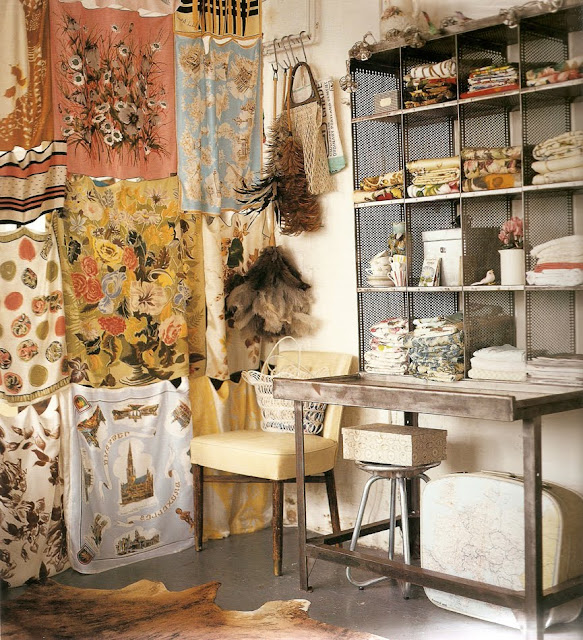 A secret workspace in this loft is kept separate from the rest of the living spaces by a curtain of stitched scarves and tea-towels. Galvanized storage shelves and a heavy metal desk provide beautiful contrast, as well as a utilitarian work area for this crafter.
 Display is so much a part of the flea-market look. This rustic old cabinet holds a bevy of flea market finds. Isolating your flea market collections to one area, or even one cabinet in the corner of a room, is a fine way to limit the look while still providing the eye with a focus of interest.
 Another space I adore! This long farm table and its collection of wooden swivel chairs provide just the counteraction necessary to make that old steel filing cabinet pop from the wall. The blend of the wood with the metal (also in the lamps overhead and the bases of the chairs below) gives the room a tactile, utilitarian look that lends itself perfectly to working.

 Hostas in bloom in the background. Astilbes in the foreground. I love the layering of height and the texture of the foliage against the silhouette of that locust tree.
 A grouping of asters and cosmos created a fluttery, violet tableau in one corner of a garden.
 I'm not sure what these little plants are, but they may be a variety of astilbe. I love how they catch the tone of the ornamental grass in the background.
 These flowers were gorgeous: low to the ground and very prolific.
 The formal rose garden, unfortunately, fell victim to a scrourge of rose beetles. This little monster's belly is full of petal and leaf matter. The roses don't stand much of a chance against a hungry enemy like this.
 As you can see, many of the blooms have already been eaten. The buds that are yet to flower are prime prey. The foliage too is falling victim to pests and disease.
 This rose is mostly intact, but the beetles have already begun to nibble....
 This cedum is just beginning to turn its classic shade of rusty red as autumn approaches. I love this tableau of texture.
 This formidable Scotch thistle was about to burst into bloom. When it does bloom, it will be a deep shade of purple. This variety is Scotland's official flower, hence its name. They are large and very robust, strikingly beautiful with all their thorny leaves and prickles and their large, crown-like blossoms - not at all like their weedy cousins.
 The Scotch thistle yields a striking silhouette against the gray sky.
 A field of foxgloves growing behind a long cedar hedge was a wonderful surprise.
 Purple and cream varieties only.
 All of this foliage will be exciting when it starts to turn shades of gold, rust and red in the autumn.
 This house, which fronts the park, looked exceptionally beautiful.


 New, personalized invitations by Martha Stewart from Pingg. Choose a photo from the gallery and add your personal details.
 This hanging skeleton from Martha Stewart Crafts is a steal for $6.99!

 You may remember this silhouette from the cover of the October, 2005, issue of Martha Stewart Living magazine. It's now available at Grandin Road.
 These large, colourful, glittered chandeliers are made of cardboard and easily snap together for a striking effect, available at Grandin Road.
 New this year from Flor is a line of Halloween-themed carpet tiles, to make the entrance to your home even more spooky to roaming trick-or-treaters.
 Martha Stewart for 1-800-Flowers offers several new fall bouquets and wreaths, including the Jack-O-Lantern pumpkin patch bouquet.
 More glittered chandeliers from Martha Stewart Crafts. And I love this Happy Halloween witch garland for just $5.99. The font is effectively vintage.


